Construction sequencing changes around active operations because the project must protect people, business continuity, access, utilities, indoor conditions, and daily communication while the work is underway. The sequence becomes less about fastest installation and more about safe, predictable phasing.
TL;DR: In an active facility, sequencing should start with operations mapping. Identify who uses the space, what cannot be interrupted, when noisy or dusty work can happen, how utilities will be isolated, and how each phase returns the area to safe use.
Active operations add constraints the drawings do not show
An empty shell lets crews focus on trade order, material flow, inspections, and weather. An operating school, clinic, store, plant, office, or apartment building adds living constraints. People still need access, exits, deliveries, air quality, security, and predictable schedules. A technically correct sequence can still fail if it blocks a loading dock or creates dust near sensitive occupants.
The NIOSH guidance on indoor environmental quality during construction and renovation highlights issues such as lack of dust control, high-emission materials, and limited communication with occupants. That is a useful reminder that sequencing is partly a health and communication plan, not only a construction plan.
For beginners, the simplest way to think about active-facility sequencing is this: every construction activity has a shadow. Cutting creates noise and dust. Demolition creates debris routes. Shutdowns affect users outside the immediate room. Deliveries affect traffic. Inspections affect access. The schedule must account for those shadows.
Empty-site sequencing vs active-operation sequencing
| Planning question | Empty or vacant project | Active operations project |
|---|---|---|
| Who controls the space? | Mostly the construction team | Shared with owner, occupants, security, and operations staff |
| What drives phasing? | Trade logic and inspection order | Business continuity, safety, access, and trade logic |
| When can disruptive work occur? | Longer work windows are often possible | Work windows may be nights, weekends, breaks, or short shutdowns |
| How are utilities handled? | Broader shutdowns may be easier | Isolation, temporary service, and advance notice matter more |
| How is progress measured? | Installed work and inspection milestones | Installed work plus safe return of each area to use |
This is why a project team should discuss operations before finalizing the sequence. The plan may need to split one efficient construction area into smaller zones because the organization cannot release the full area at once. It may also need temporary partitions, alternate routes, or night work to keep core activities running.
Map operations before mapping construction
Start with a walk-through that focuses on how the facility works. Ask when people arrive, which doors are critical, where deliveries happen, where noise is most disruptive, which systems cannot go down, and which rooms support revenue, care, teaching, production, or tenant commitments. In a facility with repeated maintenance stress, this mapping can also expose chronic deferred maintenance causes that should be separated from the project scope.
The operations map should identify:
- Occupied zones and sensitive users.
- Emergency egress and accessible routes.
- Utility systems serving areas beyond the work zone.
- Dust, odor, vibration, and noise-sensitive areas.
- Security checkpoints and access rules.
- Material staging and debris routes.
- Inspection and shutdown approval contacts.
Phase work by risk, not only by location
Traditional sequencing often follows location: floor one, then floor two, or area A, then area B. Around active operations, risk may be the better driver. High-disruption tasks can be grouped into protected windows. Low-disruption tasks can happen during normal operations if containment and communication are strong.
For example, ceiling investigation may happen before demolition so the team can confirm utilities, access, and hidden conditions. Noisy coring may be scheduled outside occupied hours. Finish work may be delayed until dusty tasks are complete and the space can be cleaned. Systems testing may be coordinated with building operators so alarms, controls, or shutdowns do not surprise occupants.
This is also where field leadership development matters. A supervisor working in an active facility needs to brief crews on more than installation tasks. They need to explain occupant routes, behavior expectations, restricted areas, and what to do if a user enters the work zone.
Control dust, noise, and utility interruptions
OSHA describes construction as a high-hazard industry through its construction resources, and active facilities add exposure concerns for both workers and occupants. Dust control should be planned before demolition or cutting starts. Temporary barriers, walk-off mats, local exhaust, HEPA-filtered equipment, and housekeeping routines are all sequencing items because they affect when an area can be released.
When work disturbs concrete, brick, mortar, stone, or similar materials, the OSHA crystalline silica construction guidance should be considered for worker exposure controls. Occupant protection is separate from worker compliance, but the planning mindset is similar: identify the source, control the pathway, and verify that the work area stays contained.
Utility interruptions need the same discipline. A shutdown request should define the affected system, exact window, backup plan, notification list, lockout or isolation requirements, and restoration checks. Avoid vague shutdown language such as “water off in the morning.” Active operations need exact expectations.
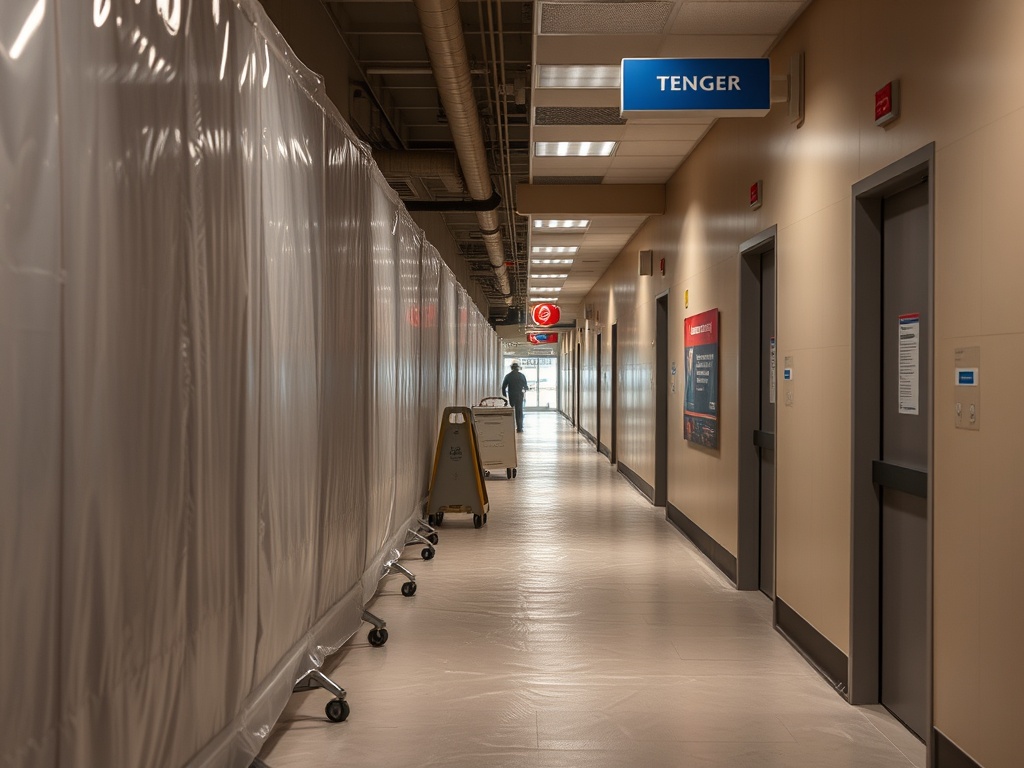
: Temporary dust containment corridor in a working building, with tools and barriers visible, no readable signage or logos.[/B]
Communication is part of the sequence
The best phasing plan can still fail if occupants hear about disruption too late. Communication should be built into the schedule as a deliverable. Each phase should have a notice date, message owner, affected audience, expected disruption, and feedback channel.
Good communication is specific: “East entrance closed Tuesday from opening to noon; use the south entrance” is useful. “Construction activity may occur” is not. For longer projects, use weekly look-aheads that show upcoming noisy work, access changes, and utility impacts. Keep the message short enough that occupants will read it.
Common sequencing mistakes
Active-operation projects often go wrong because the team underestimates small transitions. Moving a crew through a lobby, storing materials in a corridor, using a passenger elevator, or leaving a ceiling open overnight can trigger complaints or safety issues. Another mistake is assuming the owner representative knows every operational detail. Department managers, security teams, custodial staff, and maintenance staff often know constraints that never appear in the project kickoff.
Avoid these traps:
- Starting demolition before containment and routes are approved.
- Scheduling shutdowns without testing isolation points.
- Using one generic notice for all occupants.
- Forgetting inspections, cleaning, and turnover time inside each phase.
- Allowing deliveries to conflict with peak operating hours.
- Treating temporary work as informal because it will be removed later.
Active-facility sequencing checklist
Before releasing the schedule, confirm that each phase answers these questions:
- Who is affected by this phase?
- What operations must continue during the work?
- Which routes, exits, and services must remain open?
- What dust, noise, odor, vibration, or security controls are needed?
- What utility shutdowns or temporary services are required?
- Who approves the work window?
- What has to be cleaned, inspected, or restored before reopening?
- Who communicates the change to occupants?
This content is for informational and educational purposes only. It is not professional engineering, safety, legal, code, compliance, or project management advice. Active-facility work should be planned with qualified professionals and local requirements in mind.
Plan the work around the business, not only the building
Sequencing around active operations is successful when the project team understands the facility’s daily rhythm. Walk the site, map operational risks, phase disruptive work carefully, and treat communication as a construction activity. A practical next step is to create a one-page phase risk matrix before the next schedule review.