How to Validate a Business Idea Before You Spend Real Money
You can validate a business idea cheaply by testing the customer problem, willingness to pay, acquisition path, delivery feasibility, and basic economics before committing major money.
Validation is not asking friends if an idea sounds good. It is gathering evidence that a specific customer has a meaningful problem, accepts a proposed solution, can be reached at a reasonable cost, and may pay enough for the business to work.
Validation Takeaways Before Spending
- Define the customer and problem before building a product.
- Use interviews, landing pages, prototypes, preorders, or small pilots to test behavior.
- Check market size and competition with credible public data.
- Set a kill, revise, or proceed rule before spending more.
Write the riskiest assumption first
Most ideas contain several assumptions: customers have the problem, they care enough to act, the solution is credible, the price is acceptable, the company can deliver profitably, and buyers can be reached. The first validation step is to identify the assumption that would make the idea fail if it is false.
For example, a meal-prep concept may not be risky because recipes are hard. It may be risky because local customers will not pay enough for delivery, or because compliance and kitchen capacity make unit economics unattractive. A B2B software idea may not be risky because the feature can be built. It may be risky because the buyer is not the user and the sales cycle is too long.
Use market research without hiding behind it
Talk to noncustomers as well as likely buyers. People who reject the idea can reveal switching barriers, timing issues, budget constraints, and substitutes that fans may overlook. Those objections often improve the offer faster than praise.
Public data can help determine whether a customer group exists and how competition behaves. The SBA's market research and competitive analysis guidance explains how market research and competitive analysis work together. The Census Business Builder can also help small-business owners use economic and demographic data when considering a market.
Market research is a starting point, not proof of demand. A large market does not mean your offer will sell. Competitor presence does not mean the idea is bad; it may show demand. The validation question is narrower: can this business reach a clear buyer with a better, cheaper, faster, more convenient, more trusted, or more specialized option?
[Image Placeholder 1: A founder testing a business idea with blurred customer notes, prototype sketches, and market research on a desk.]

Choose a test that measures behavior
| Assumption | Low-cost test | Good evidence |
|---|---|---|
| Problem exists | Customer interviews focused on recent behavior | Specific stories of pain, cost, delay, or workaround |
| Buyer will act | Landing page, waitlist, consultation request, or preorder | People take a real next step |
| Price is plausible | Price test in proposal or pilot offer | Prospects do not only praise the idea, they discuss terms |
| Delivery is feasible | Manual pilot or concierge version | The company can fulfill without hidden chaos |
| Channel works | Small paid test, partner referral, or outreach sequence | Cost and conversion look directionally viable |
The strongest early tests involve behavior. Compliments are weak evidence. Email signups are better. Deposits, signed letters of intent, paid pilots, booked calls, and repeat use are stronger. The right evidence depends on the business model, but the principle is stable: ask people to do something realistic.
Keep spending proportional to learning
Validation should protect cash. Before building a full product, buy only enough learning to make the next decision. That may mean a prototype, a manual service pilot, a no-code workflow, a small ad campaign, a sample product batch, or a limited partner test. Spending should rise only when risk falls.
This is also where decision quality matters. A founder can become attached to an idea and interpret weak signals generously. A written decision rule, such as proceed if ten target customers book paid pilots within 30 days, reduces wishful thinking. That discipline connects with Decision-Making Frameworks for Leaders Under Pressure.
Map the business model before scaling
An idea may be desirable but still unattractive as a business. Model the basics before hiring, ordering inventory, or building complex systems: price, cost to acquire a customer, cost to serve, gross margin, delivery capacity, refund or churn risk, cash collection timing, and repeat purchase. The model will be rough, but it should show which metric must be true for the business to work.
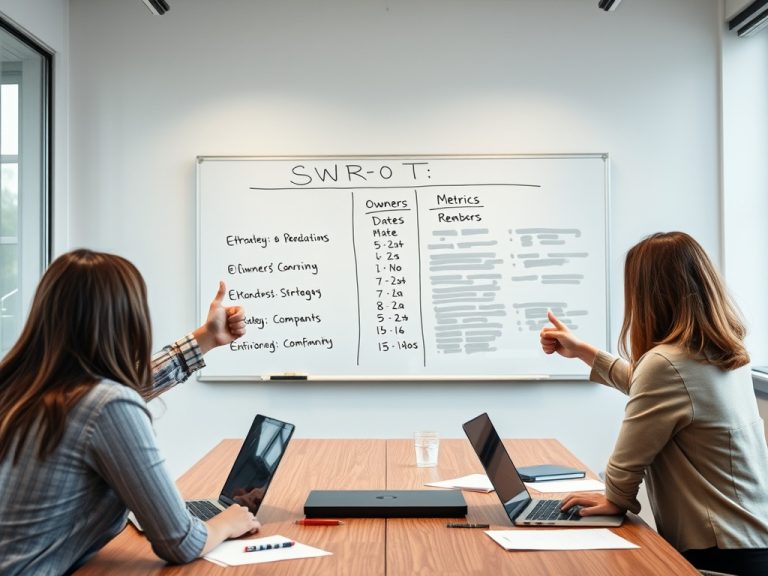
A simple SWOT can also organize early findings, as long as it does not become a decorative slide. Use How to Run a SWOT Analysis Without Creating a Useless Slide Deck to turn customer evidence, competitor research, internal capability, and market risk into decisions.
Make the next funding decision explicit
At the end of a validation cycle, choose one of three paths: proceed, revise, or stop. Proceed only if the evidence clears the rule you set in advance. Revise if the problem is real but the segment, offer, price, or channel needs adjustment. Stop if the evidence shows weak demand, unattractive economics, or delivery risk that the business cannot absorb.
A practical next step is to write a one-page validation plan for the idea. Name the target customer, riskiest assumption, test method, budget cap, evidence threshold, timeline, and decision rule. That plan is cheaper than building first and explaining later.